AORA Studio
Pilates for Desk Workers
Undo 8 hours of sitting in 50 minutes.
Last updated February 2026
What sitting actually does to your body
You already know sitting all day is not great for you. But the specifics matter, because they explain exactly why reformer pilates is such an effective counter-measure.
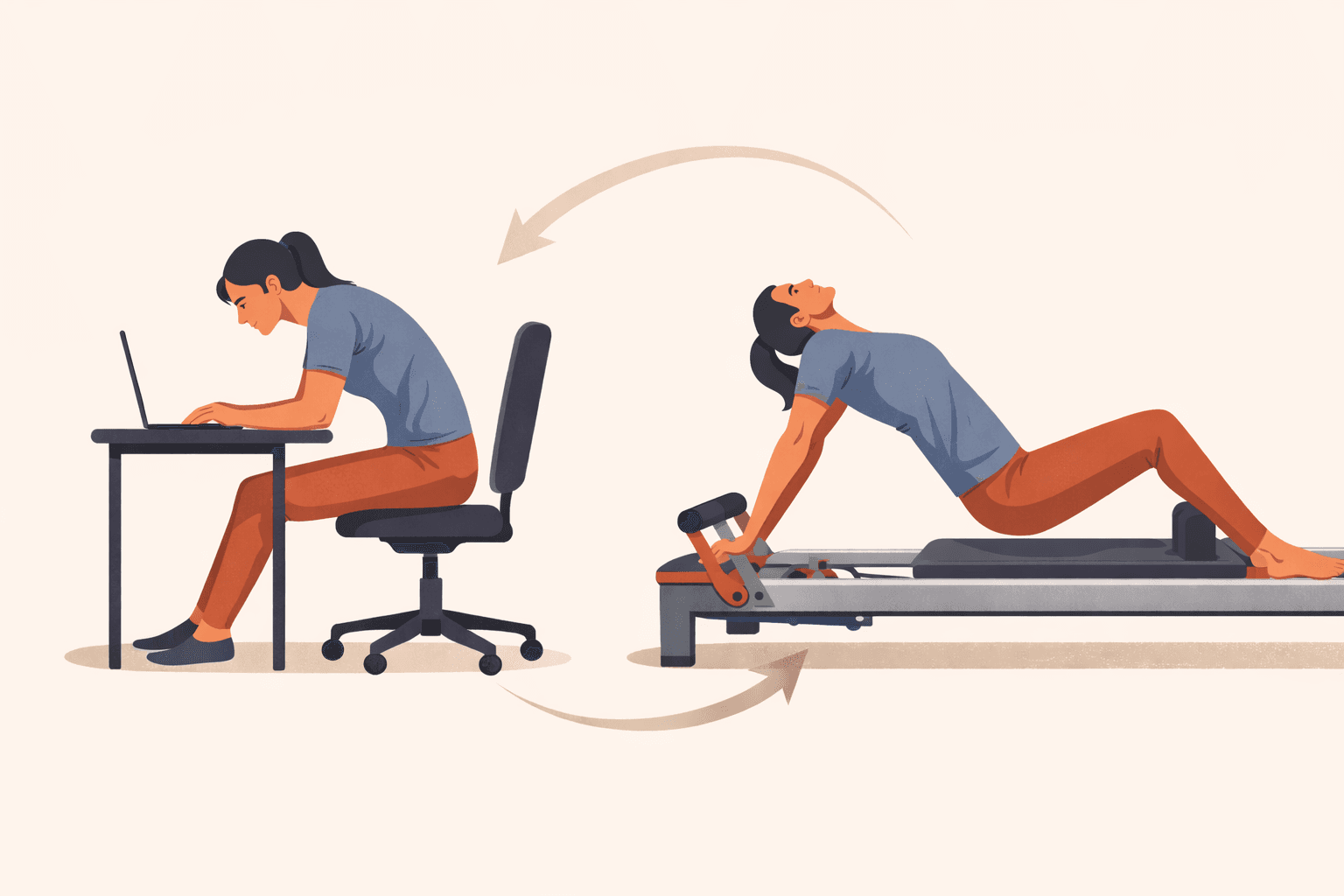
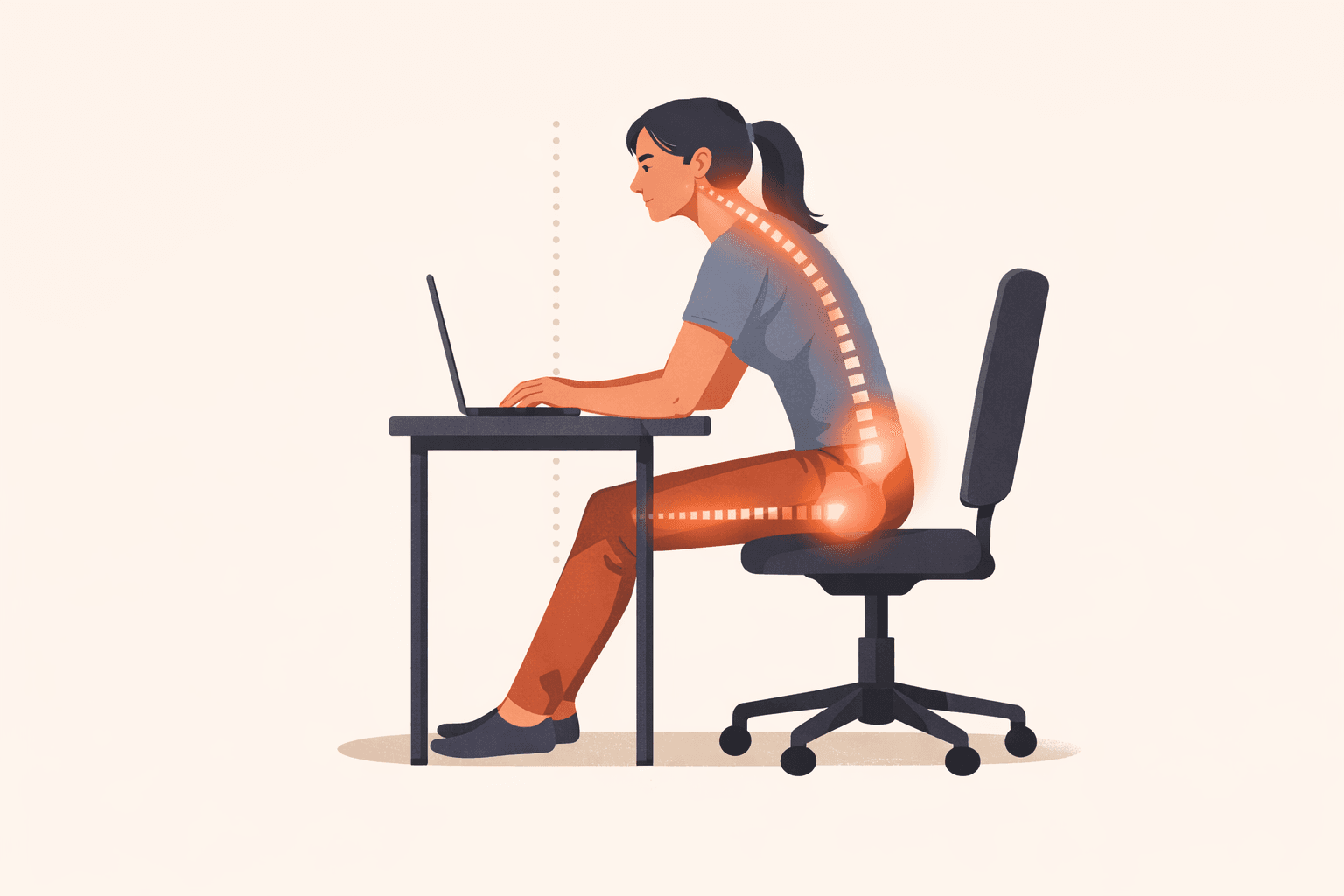
When you sit for extended periods, your hip flexors shorten and tighten, pulling your pelvis into an anterior tilt. Your glutes effectively switch off because they have nothing to do. Your upper back rounds forward as your shoulders collapse towards your screen. Your deep core muscles disengage because your chair is doing the stabilising work for them.
This is not damage from a single bad day. It is a gradual reprogramming of your posture that happens over months and years. Your body adapts to the position it spends the most time in, and for most desk workers, that position is a problem.
The predictable pain pattern
Desk workers tend to present with a remarkably consistent set of complaints: lower back stiffness, neck and shoulder tension, tight hips, and a vague sense that their body feels older than it should.
These are not separate issues. They are all connected to the same postural pattern. Tight hip flexors pull on the lower back. Weak glutes fail to support the pelvis. Rounded shoulders compress the neck. The body is a chain, and when the middle links stop working properly, the ends take the strain.
Painkillers, standing desks and ergonomic chairs all address symptoms. Reformer pilates addresses the cause.
How the reformer reverses the pattern
The reformer is particularly effective for desk workers because it systematically targets every muscle that sitting weakens and stretches every muscle that sitting shortens. It is almost as if it was designed for this purpose.
Hip flexor stretches on the carriage lengthen the muscles that hours of sitting have compressed. Bridging exercises reactivate the glutes. Spinal articulation work mobilises each vertebra individually, reversing the stiffness that accumulates through a sedentary day.
Upper back extension exercises open the chest and strengthen the muscles between the shoulder blades, counteracting the forward-shoulder posture that screens create. Core engagement happens automatically because the moving carriage demands constant stabilisation.
The lower back relief
Lower back pain is the single most common complaint among desk workers who come to AORA. In the vast majority of cases, the back itself is not the problem. The problem is upstream (weak core and glutes) and downstream (tight hip flexors and hamstrings).
The reformer addresses all four simultaneously. Within a few weeks of regular sessions, most clients report a noticeable reduction in lower back discomfort. Not because we have treated the back, but because the muscles around it have started doing their job properly again.
This is not a quick fix. It is a genuine structural improvement in how your body supports itself. The relief tends to be lasting because the underlying cause, muscular weakness and tightness, has been resolved rather than masked.
Posture that holds itself
Good posture is not about forcing yourself to sit up straight. That requires conscious effort and lasts about 15 minutes before you slump back. Real posture improvement comes from strengthening the muscles that hold you upright so they can do their job without you thinking about it.
The reformer builds exactly these muscles. The deep core, the posterior chain, the scapular stabilisers. After several weeks of consistent practice, clients find themselves sitting taller at their desk, not through willpower but because their body defaults to a better position.
Colleagues notice. Partners notice. You notice it when you catch your reflection. The change is visible and it happens faster than most people expect.
The energy shift
There is a less obvious benefit that desk workers consistently report: more energy. This seems counterintuitive. You are adding exercise to an already full schedule. Surely that should make you more tired, not less.
The explanation is straightforward. Sitting in a compressed position restricts breathing and reduces circulation. Your body is not getting enough oxygen or blood flow to function at its best. A reformer session opens your ribcage, deepens your breathing, and restores healthy blood flow to muscles that have been static for hours.
Most of our evening clients are desk workers who come to the studio after work. They arrive stiff and drained. They leave 50 minutes later feeling physically reset. It is one of the most immediate and tangible benefits of the practice.
Fitting it around a full work schedule
We built our timetable with Bristol professionals in mind. Early morning classes let you move before the work day begins. Evening sessions offer a reset after hours at a screen. At 50 minutes, a class fits comfortably into a lunch break if your schedule allows.
One to two sessions per week is enough to counteract the effects of desk work. You do not need to commit to a daily practice. The reformer is efficient precisely because it addresses so many issues in a single session.
If you can only manage once a week, that is still worth doing. Once is better than never, and the cumulative effect over months is significant. Your body will thank you for even a small investment in movement.
- One to two sessions per week counteracts most desk-related tension
- Morning, lunchtime and evening classes available
- Sessions are 50 minutes and target every sitting-related issue
- Noticeable lower back relief within the first few weeks
- Better posture, more energy, and less stiffness at your desk
“Your body keeps a record of how you spend your day. Give it something better to remember.”
Break the pattern
Try 3 reformer pilates classes at our Bristol studio and feel what your body can do beyond the desk.