AORA Studio
Reformer Pilates for Runners
The cross-training session your body has been asking for.
Last updated February 2026
Why runners need more than running
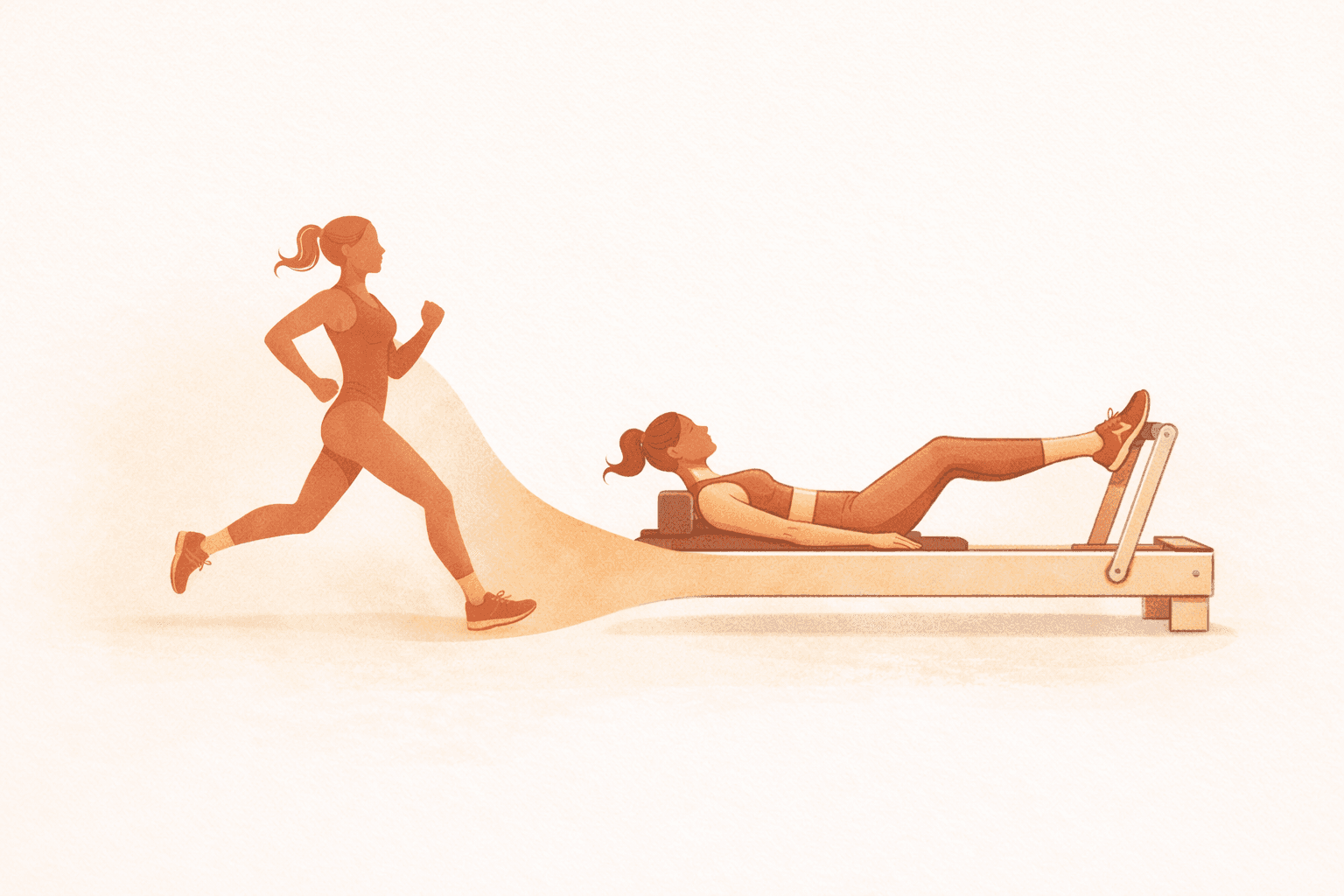
Running is brilliant. It clears your head, builds cardiovascular fitness, and asks very little in terms of equipment. But it is also deeply repetitive. Every stride loads the same joints, the same muscles, in the same plane of motion, thousands of times per session.
Over time, that repetition creates imbalances. Your quads overdevelop while your glutes underfire. Your hip flexors shorten. Your calves tighten. The small stabilising muscles around your ankles, knees and hips never get challenged in the way they need to be.
This is where most running injuries start. Not from a single bad step, but from accumulated imbalance that eventually finds a weak point. Cross-training is not about replacing running. It is about giving your body the balance it cannot get from running alone.
Where runners typically break down
If you have been running for any length of time, at least one of these will sound familiar: tight IT bands, knee pain, shin splints, plantar fasciitis, lower back stiffness, or hip flexor strain. These are not random ailments. They are predictable consequences of a movement pattern that only works in one direction.
Running is a sagittal plane activity. You move forwards. Your body never moves laterally, never rotates under load, never has to stabilise against resistance in unfamiliar positions. The muscles that handle those tasks gradually weaken from disuse.
The result is a body that is very good at one thing and increasingly vulnerable to everything else. A strong runner with weak lateral hip stability is a knee injury waiting to happen.
How the reformer addresses the gaps
The reformer is unusually well suited to runners because it allows controlled, resistance-based movement across multiple planes. You can load your legs while lying down, removing spinal compression. You can work your hips through their full range of motion with spring resistance guiding the movement.
Specific exercises target exactly the areas where runners are weakest. Footwork on the reformer strengthens the arches and ankles in ways that running never does. Side-lying leg series activates the gluteus medius, the lateral hip stabiliser that most runners neglect entirely.
Spinal articulation exercises decompress the lower back after the repetitive impact of running. And because the carriage moves on rails, you can train single-leg stability and balance under resistance without the jarring impact that a gym squat rack delivers.
The hip and glute connection
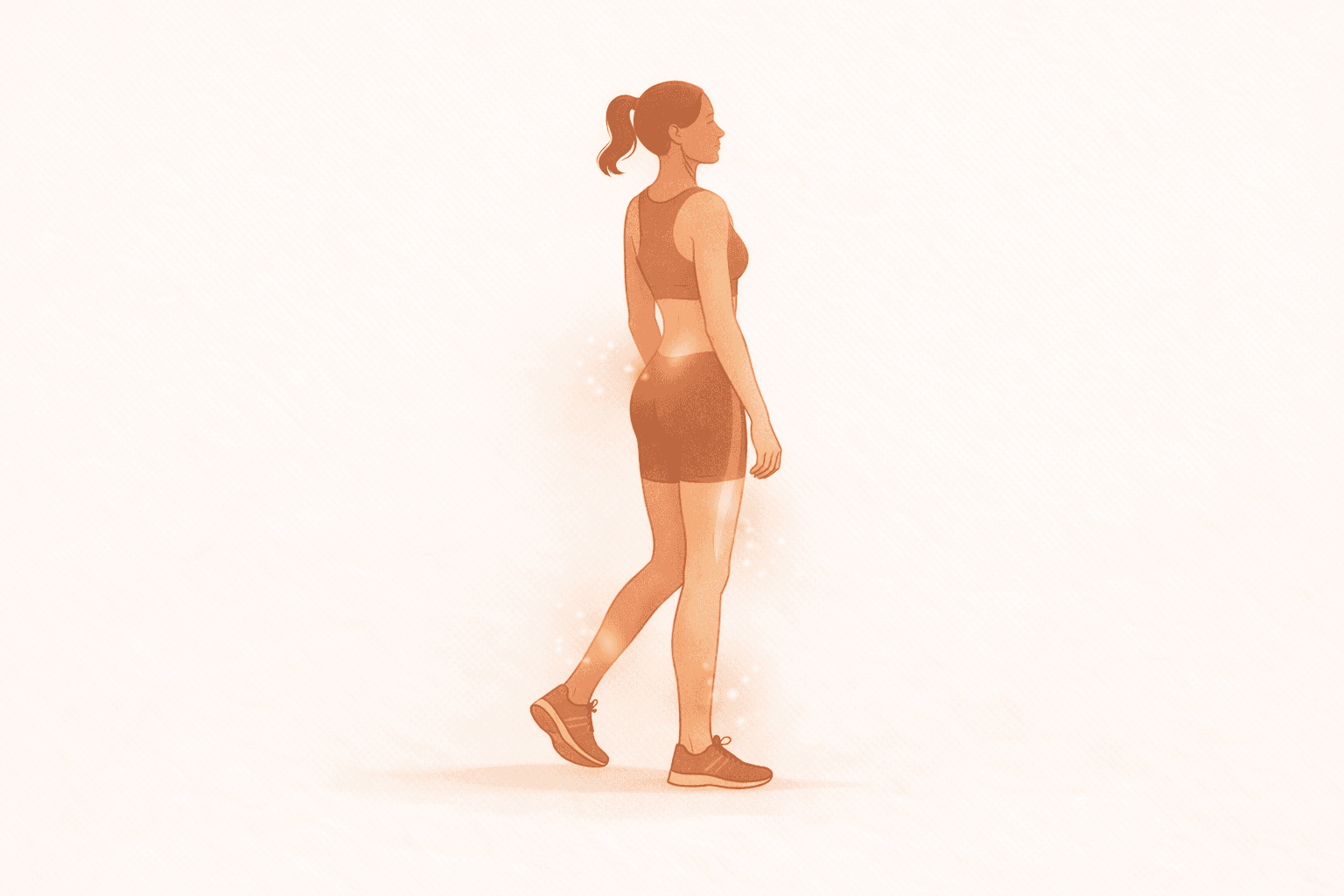
Most running injuries can be traced back to the hips. Weak glutes, tight hip flexors, and poor pelvic stability create a chain reaction that manifests as pain somewhere further down the leg. Your knee hurts, but the problem is your hip.
Reformer pilates is exceptional at glute activation. Exercises like bridging on the carriage, single-leg presses, and standing lunges with spring resistance force your glutes to fire in a way that running rarely demands. The springs provide progressive resistance, so you can build strength gradually without overloading joints.
After 4-6 weeks of consistent reformer sessions, most runners notice their glutes engaging more naturally during runs. That improved activation translates directly into more stable knees, a more efficient stride, and less pain.
Flexibility without losing power
Runners are famously tight. Hamstrings, hip flexors, calves, and IT bands all shorten and stiffen with high-mileage training. Traditional static stretching helps, but many runners skip it because it feels passive and disconnected from their training.
The reformer offers something different: active flexibility. You lengthen muscles while they are under load, which improves range of motion and teaches your body to be strong throughout that range. This is genuinely more useful than passive stretching for athletic performance.
Exercises like leg circles in the straps, hip flexor stretches on the carriage, and hamstring work on the foot bar combine strength and flexibility in a single movement. You finish the session feeling longer and more open, but without the sense of being loosened or destabilised.
Recovery without sitting still
One of the hardest things for runners is rest days. You know you need them, but sitting still feels counterproductive. Reformer pilates solves this neatly by providing a low-impact session that aids recovery without adding training stress.
The spring-assisted movements increase blood flow to fatigued muscles, helping clear metabolic waste and deliver nutrients for repair. The controlled tempo encourages deep breathing and activates the parasympathetic nervous system, the part of your body responsible for rest and recovery.
Many of our runners at AORA use a reformer class as their active recovery day. They come in stiff and leave feeling mobile, without having added any impact load to already-tired legs.
How to fit it into your training
You do not need to overhaul your running schedule. One to two reformer sessions per week is enough to see meaningful benefits. Most runners find the best results by placing a session on a recovery day or the day before a longer run.
If you are training for an event, consider the reformer as your strength and mobility session rather than adding it on top of a full gym programme. It covers enough ground - core, glutes, hip stability, ankle strength, flexibility - that it can replace several isolated exercises.
Start with one session per week for the first month. Pay attention to how your body responds on your next run. Most people notice the difference within 3-4 weeks, particularly in hip stability and post-run recovery time.
- One to two reformer sessions per week is ideal for runners
- Place sessions on recovery days or before long runs
- The reformer can replace separate gym strength work
- Expect noticeable improvements within 3-4 weeks
- Focus on glute activation, hip mobility and ankle strength
“The best runners are not just strong in one direction. They are balanced, stable and resilient.”
Add balance to your training
Try 3 reformer pilates classes at our Bristol studio and feel the difference in your running.